

A few weeks ago, I was contacted by Oklahoma Voice and asked to produce a story about the apparent vitriol between the Oklahoma Secondary School Activities Association and elected Republicans, from Gov. Kevin Stitt to the legislature.
Though I received internal praise for the reporting, the finished product was entirely rearranged. Only the quotes appeared to survive intact.
The thing is, even when reporting, rather than writing opinion backed by reporting, my voice and the narrative it produces remains. But a straight-up newsroom like Oklahoma Voice is mostly not about voice and narrative.
I promise, this is going somewhere.
For example, here are some of the opening bars I turned in to Oklahoma Voice.
By Clay Horning
OKLAHOMA CITY — On Feb. 16, the Oklahoma Secondary School Activities Association decided, among nine schools wanting out of district play come next football season, which would get their wish …
Some will agree with the OSSAA’s rulings and others will vehemently not. So it goes for the facilitator and regulator of high school sports in Oklahoma.
“The OSSAA’s always been easy to attack, because at some point in somebody’s life there was a bad call at a game, or [a team] got seeded badly or they had to go 200 miles to play instead of 100,” said Kevin Hime, superintendent of Lawton Public Schools and president of the OSSAA’s 15-person board of directors, each elected by member schools and districts …
Governed by its board, a constitution and a 42-page rulebook, and led by executive director David Jackson, the OSSAA makes and enforces the rules, facilitates scheduling and crowns champions from Class B to Class 6A in sports and non-sports activities like band or speech and debate …
“A lot of people don’t fully understand the scope of our work,” Jackson said. “I think the majority of the people think it’s dealing with eligibility only.”
It’s not, but it’s the issue Gov. Kevin Stitt took on when he called for the OSSAA’s abolition during his Feb. 2 State of the State address.
And here are they are again, edited for publication.
By Clay Horning
OKLAHOMA CITY — Over a month after Oklahoma’s governor called for the abolition of an organization that governs high school athletics, lawmakers remain divided over whether the century-old body needs an overhaul.
Supporters of the Oklahoma Secondary School Activities Association contend that the body has become a scapegoat for providing unpopular, but needed, regulatory oversight. But a group of vocal critics, including Republican Gov. Kevin Stitt, argue that times have changed, and the organization is failing to keep up with new state laws and the needs of student athletes.
“The OSSAA’s always been easy to attack because at some point in somebody’s life there was a bad call at a game, or (a team) got seeded badly or they had to go 200 miles to play instead of 100,” said Kevin Hime, superintendent of Lawton Public Schools and president of the OSSAA’s 15-member board of directors, which is chosen by member schools and districts …
Legislative efforts to intervene or dismantle its oversight abilities could lead to paying high school athletes, which is already happening, or giving coaches latitude to recruit youth to transfer to specific schools in a bid to create powerhouse teams, Hime said …
“A lot of people don’t fully understand the scope of our work,” said David Jackson, OSSAA executive director. “I think the majority of the people think it’s dealing with eligibility only.”
The edited version is better, even if it’s taken time to accept.
I thought my first priority was to explain what the OSSAA actually is and to then report the conflict. It was a priority, yet better placed within the reporting of the conflict.
C’es la vie.
Now we get to the point, one prefaced by two more points.
One, the governor did not realize his dream to abolish the OSSAA and, good chance, knew he wouldn’t all along. Two, the legislators who gave him a standing ovation for saying it should be abolished, well, they had no appetite for doing it in the first place.
Finally, why we’re here:
In an effort to calm the waters, what the OSSAA has just now done in response to the conflict — with one caveat I’ll share at the end — will not begin to ease the conflict with its detractors.
On Monday, reported The Oklahoman, the OSSAA announced it would establish a committee to review the 24 rules in its 35-page rulebook.
The committee will consist of 12-to-15 members who may be nominated by any of the OSSAA’s member schools.
It will meet once a month between May and December to, as the Oklahoman reported, “pitch changes to the OSSAA board of directors.”
Approved changes would then go to a majority vote among member schools.
“What makes this committee different is that it takes a fresh, thoughtful look at these rules and opens up each change to the board and then member schools for voting,” OSSAA executive director David Jackson said. “We want everyone to know these decisions were made with students and families in mind.”
Also, it’s exactly what state senate president pro tempore Lonnie Paxton (R-Tuttle) told me he didn’t care for.
“What I have heard at this point is they’re considering some type of advisory board. I’m not much interested in that one,” he said the last week of February. “That’s just a board that really would have no power, other than, I think, it’s just kind of patting the legislature on the back of the head and sending [it] down the road.”
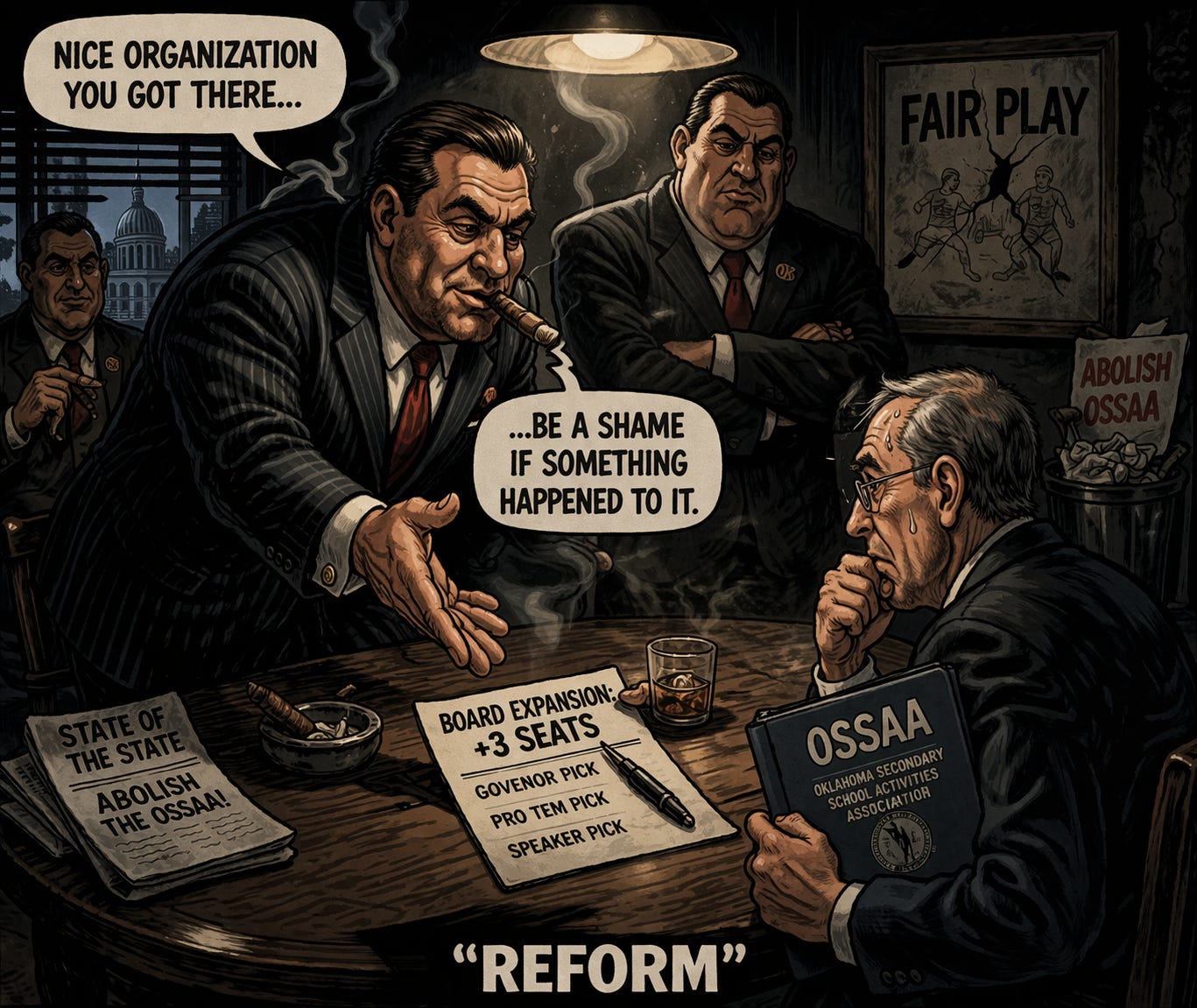
What Paxton wants to see, instead, is a change to the OSSAA’s 15-member board.
“Let the governor, pro tem of the senate and the speaker of the house each have an appointment on the board,” he said. “Just add three spots on the board.”
Paxton believes the board is too insular, made up entirely of school officials rather than parents or others who might better see the forest from the trees.
As one who’s spent a lifetime in sports trying to discern both the forest and the trees, the pros and cons to Paxton’s idea both make all the sense in the world.
Pro, it’s an easy fix.
Just add three new non-school officials to your board. What could go wrong, it’s just three of 18 for crying out loud and the legislature, or most of it, is finally off your back.
Just do it, securing the OSSAA’s future along the way.
Con, talk about mob tactics.
Hey, it would be a terrible thing if your organization ended. Nobody wants that, so just give us a seat at the table. If you don’t like our ideas, you still outnumber us.
Then come the ghost employees, crushed profits and, maybe, arson.
We’ve all seen the movies.
Though I wouldn’t put it past the truest believers in his party, the sarcastic con path doesn’t sound like Paxton.
“I want the legislature to have no part in running that organization,” he said. “I think that organization needs to stay intact. I think, overall, they do a pretty good job.”
Still, when everybody stood and applauded the governor’s wish to end that organization, Paxton stood and applauded, too.
I also spoke to Casey Murdock (R-Felt), the author of Senate Bill 1890, designed to replace the OSSAA with the OAAC — Oklahoma Athletics and Activities Commission — a measure I originally wrote about here.
In the Feb. 3 press release introducing the bill, Murdock could not have been more clear.
“The OSSAA is governed by a group of unaccountable, out-of-touch bureaucrats who are making money on the backs of Oklahoma children while issuing arbitrary decisions preventing students from participating in school sports,” he said. “Past attempts to reform the OSSAA have failed, and it has become impossible to reason with its board of directors.
“It’s clear that the Legislature must start fresh and form a new, more accountable and transparent organization to oversee school sports and other after-school activities.”
Funny.
When I spoke to him three weeks later, he’d changed his tune.
“You know, I’m not expecting my bill to be done this year,” he said. “It’s too big a move, and I don’t want it done this year, because it’s too big a move.”
Finishing our call, I had a thought.
Addressing the masses, they speak in the most charged and least thoughtful tones. Speaking to somebody who knows their stuff, who’s not coming to them for explanation but answers, they relax and become their alternate reasonable selves.
Perhaps they should not have radicalized, or allowed the radicalization, of their voters.
Where were we?
Ah, yes, the OSSAA.
“Being a target … none of us like that,” Jackson told The Oklahoman. “And the first reaction, being human, is to get upset and bothered by it, so we’ve gone through that period. But here’s the thing … we can use this as an opportunity to to get better.”
Maybe, but it’s unlikely to impress anybody at the state house, even while the OSSAA’s certain to feel like it’s turned over a new leaf.
“When parents don’t feel like they’re being treated [well] by … something like the OSSAA, it eventually rises up to their state legislators,” Paxton said. “So legislators have brought their concerns to that organization multiple times and that organization, multiple times, has pretty much thumbed their nose at the legislature.”
Now it will appear the OSSAA has done it again, a “review” board sounding very much like the “advisory” board Paxton spoke against.
The caveat?
The OSSAA could just go along with universal open transfer, allowing ultimate school choice to all athletes, for any reason or no reason, who would then have every right to play football at one school, baseball at another school, football again at the original school, baseball again … for four years.
Wash, rinse, repeat.
If the OSSAA wants to insure its survival it could say yes to open recruiting, yes to tampered superteams, yes to direct payments to players, because that’s the pandora’s box universal open transfer among athletes will lead to.
It can’t not.
Do that, though, and what’s the point of survival, your first value, a fair playing field, given away.
The conflict’s bound to continue.
Given the stakes, it should.