

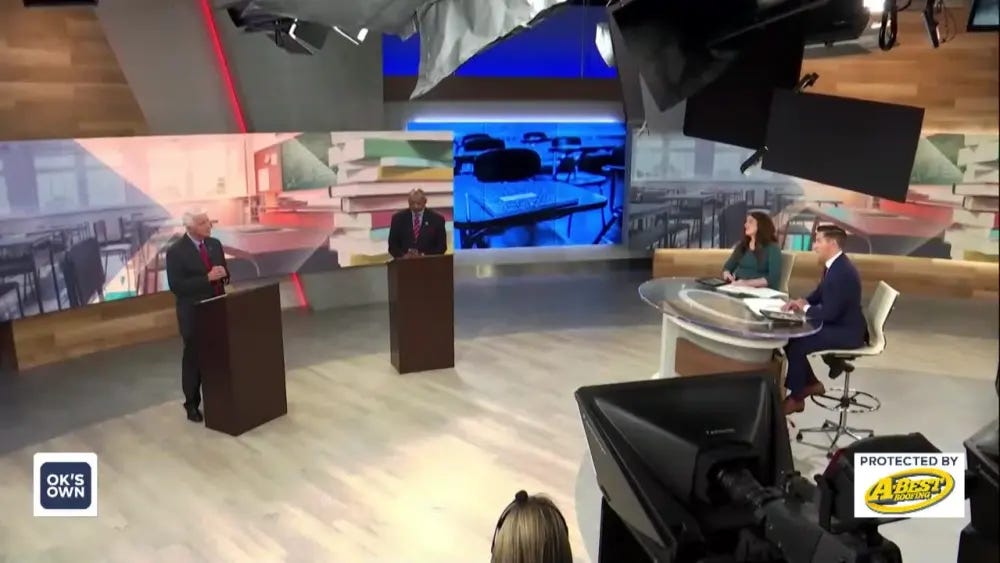
Debating James Taylor on statewide television Monday night, each hoping to become the last Republican standing in the race for state superintendent, Robert Franklin ran into an issue so many thoughtful, righteous and service-oriented candidates struggle to avoid.
Because when they really know their stuff and really want voters to understand what they’re about, they can become too precise, which can sound tedious, even aloof.
It’s a great way to govern, but perhaps not debate.
Nothing to be ashamed of.
I love candidates like that.
Lets me know they’re smart and they care.
But there’s a way to nail it and remain accessible, and I’m not sure Franklin pulled it off as well as he might have liked. Too much talk of “data” and “best practices,” terms I wonder if regular folks fully grasp.
Sorry, regular folks.
Still, if you appreciate leadership and expertise, just a couple of answers to a couple of questions were all you needed to know.
It’s a job for Franklin, one Taylor should be kept from at all costs.
Take the first volley.
Given everything the state department of education has been through since the last election, and while we know it’s not an “overnight fix,” what’s the first thing you would do “to move the needle in the right direction.”
“Lindel Fields has put some salve on the wounds at the state department of education,” Franklin began. “I think you bring him and his team in on the turnaround and you begin to say, ‘What have you learned, what gaps do you see, what questions and concerns might you have?’
“And then what begins to happen is you bring tribal leaders to the table, you bring higher ed partners, career tech partners, moms and dads … and industry partners to the table to say, ‘Let’s create a [100-day] strategic plan,’ and thus begin to put that in motion. And again, it’s not going to be what we do in a day, it’s what we’re going to do daily that’s going to make the difference.”
Got it?
Make the most of the transition with the group sent to save the department Ryan Walters destroyed. Get briefed, learn the lessons, understand size and scope. Then bring everybody in, decide what’s to be done quickly while momentum’s on your side and keep plugging away.
“The work is heavy, it’s daunting,” Franklin added, but “I think we can move in the right direction.”
He sounded like two things.
One, a leader, and two, one who’s given the challenge great thought.
Taylor?
“Well, first of all, we’ve got to make sure that our teachers are well prepared and equipped for the classroom. That they know exactly what they’re supposed to be doing. Also, we are going to be doing better simply because our legislature has put into place, brought back phonics, it brought back cursive, and there’s no social promotion, so we really have nowhere to go but up. But we’re going to be making sure that our kids can read. Our legislature says third grade. I think it should start at first grade. Actually, if kindergarten start reading, but by first grade, they should be reading at grade level. So we are going to make sure that those kids get the things that they need in their classroom for teacher preparation, as well as seeing if we can get some additional reading specialists. The legislatures did put in the budget …”
I have to cut him off.
I’m not sure how to summarize it other than to ask whether Taylor declared his candidacy in June or yesterday, because he sounded like he’d never pondered the question until the moment it was asked. And even then, given the 60 seconds Franklin spoke before he took his turn, Taylor should have come up with something better than that.
Legislature this. Legislature that.
Also, cursive?
An artistic way to pen the language, yeah, Dodger and Cardinal jerseys would be lost without it. Also a form of writing that, but to sign my name, I haven’t used since the 10th grade when I was told notes taken in “print” were more easily retained (and they are).
Further, I’m pretty sure teacher preparedness and being equipped falls almost entirely to teachers already, though I’m sure they’d love to expense getting their classrooms in shape each year.
Taylor, though, isn’t about that at all.
“We just gave teachers another $2,000 raise this year. So I am not one that says a lot of money into the issue is going to change the issue.”
Oh, brother.
“But we’re going to be making sure that our kids can read,” he said.
If only he’d explained how he’d do that.
One more.
Before the teacher-pay question, an on-screen graphic noted entry-level teacher pay in Oklahoma to be $41,294, significantly less than $54,372 in New Mexico, $49,465 in Texas and $50,076 in Arkansas, while the national average sits at $48,112.
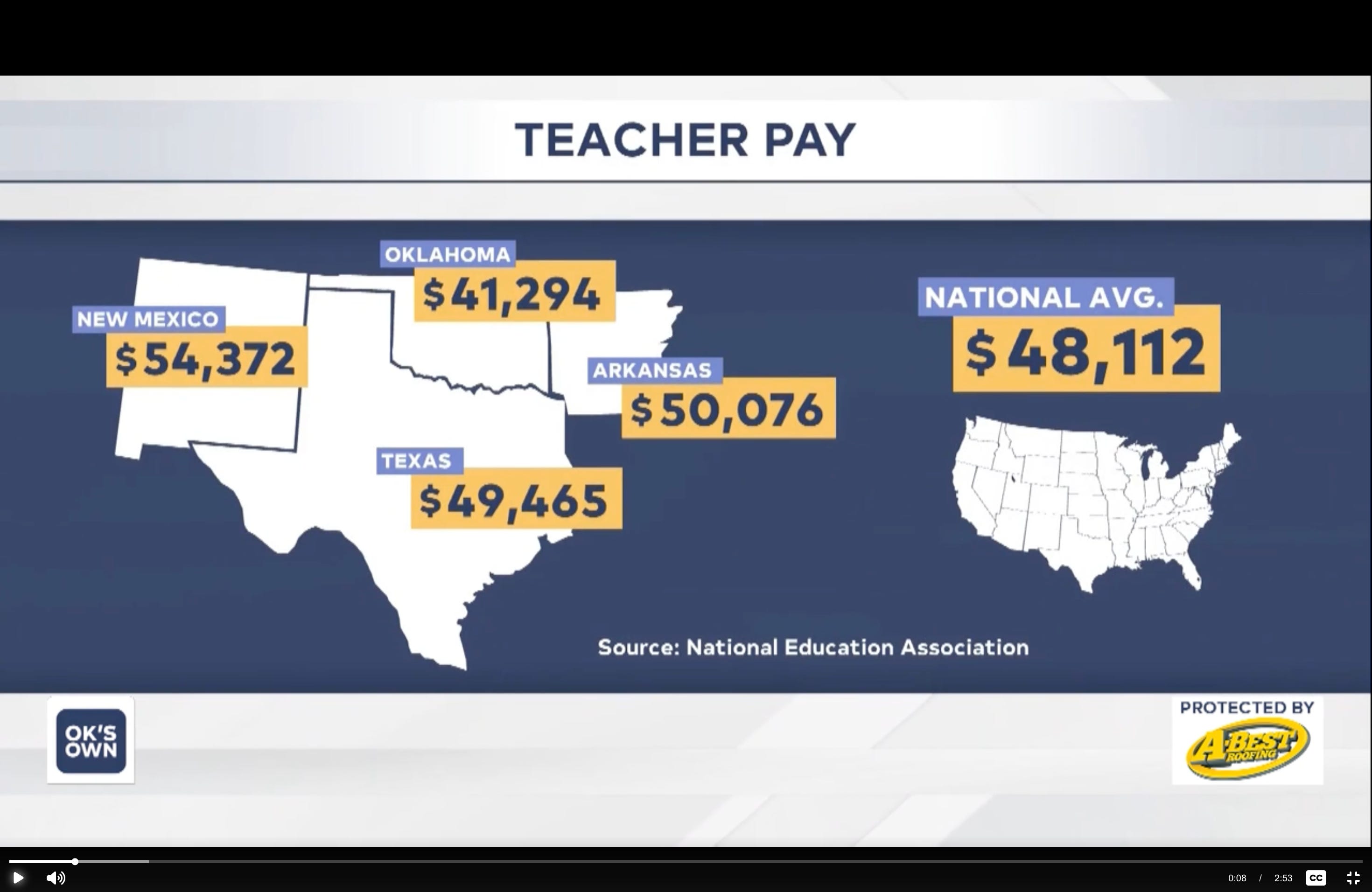
The candidates were asked whether they had a way to pay teachers more.
It was a borderline unfair question because a state superintendent can’t unilaterally and universally raise teacher pay. Only the legislature can appropriate that money. Still, a superintendent candidate ought to have a ready answer.
I wish Franklin’s had been stronger.
Yet, compared to Taylor, he shot the moon.
“I think you have to get back to that piece of the puzzle that says we only have X amount of dollars to spend, and where do we target those dollars?” he said. “And if indeed we can start to save some dollars through the process of how we redo our state assessment model, those are millions that we can also funnel back into the funding formula.
“But I also don’t think that we can take a pass on working with our legislative teams, working with business and industry partners, working with our tribal leaders, perhaps differently than we’ve ever worked with our tribal leaders before, to say, ‘Let’s all lean in together so we can make sure that we’re regionally competitive in the wages and supports that we’re providing for our educators.’”
I wish he’d led with his willingness to lobby the legislature, to fight for Oklahoma’s kids and teachers, to make clear he’d be a tireless advocate for what’s required. I’d have liked it even more if he’d borrowed that old Kelvin Sampson line: “You achieve what you emphasize.”
Still, not bad. Be efficient, remain engaged with the appropriators, get everybody aboard the train to effect required change.
Taylor?
He doesn’t want more funding.
Because who needs more resources, teachers, specialists, counselors, even a fully staffed state department of education for crying out loud? Who does he think he’s there to advocate for if he wins? Mike Mazzei, who wants to crush revenue streams and likes to call public schools “government” schools?
“We have increased funding since 2018 by 51 percent. It is the No. 1 chunk of the money that’s going into our schools, and you would think that our numbers would be going up, but they’re not, they’re not going up. Actually, they went down. So there is not a necessary correlation between more money and better results,” Taylor said. “Taxpayers want results for their money. We just gave the teachers another $2,000 raise this year, so I am not one that says a lot of money into the issue is going to change the issue.”
Well, great.
Who needs money?
Had Taylor answered the question first instead of last, Franklin might have jumped in to note Oklahoma still ranks 47th in the nation in per-pupil spending, and that you don’t just achieve what you emphasize, you tend to get what you pay for, too. Not to mention, if our state’s raised education spending 51 percent since 2018, just imagine the place to which our Republican legislatures allowed education to fall.
Hey, if you really want education to become a statewide priority, vote for Franklin on Aug. 25 and again in November, and for Dems in house and senate races.
Just some free advice.
At every turn, Franklin was more equipped than Taylor and, at every turn, Franklin was trying to solve the problem in front of him rather than yammer.
Let us hope viewers noticed only one of them sounded ready to lead, while the other made the case for an archaic type of writing as he buttered up the same legislature that refused to stand in Ryan Walters’ way. And that one stands ready to advocate for students and teachers, while the other thinks little of stepping up with the resources required to make a difference.
Who do you think will fare better?
Vote for that guy.
I will hold my nose and vote for an R candidate Franklin. I’m fed up with people bringing their historical fiction book club rules and cramming it down our throat. Maybe the madness will end when the tangerine taint is no more and the nut jobs no longer feel emboldened. I can wish.