

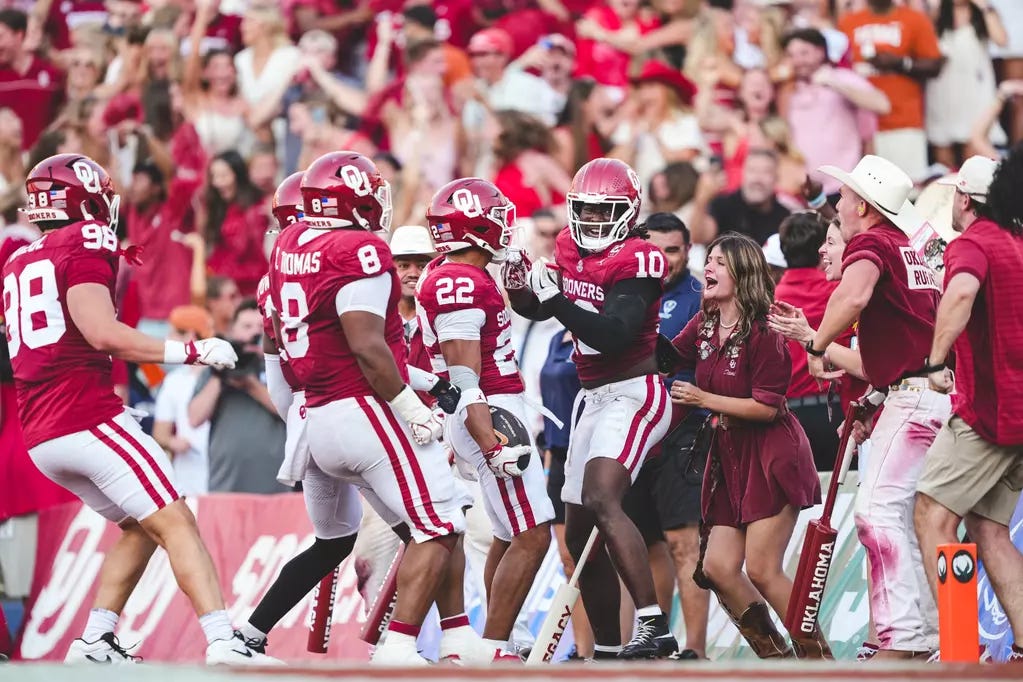
Forgive me, but I must.
Sooner head coach Brent Venables was talking about his program’s most unlikely of wins, Saturday’s 27-24 victory over No. 1 Texas, and, regretfully, he came up with some lines I still can’t get my head around.
“Peyton’s interception and the blocked punt for a touchdown were huge, game-changing plays. They always are,” he said. “But that’s what we’re capable of and for whatever reason we hadn’t just put it all together.”
That’s one.
Here’s two, John Mateer the topic.
“I thought he did a great job,” Venables said, “playing quarterback, taking care of the football, taking what was there, playing complementary football, not trying to win the game in the first quarter.”
I don’t want to rain on the parade, and I really don’t want to, because, though a mile-long series of events without which Oklahoma would never have beaten Texas in front of 92,000-plus inside the Cotton Bowl occurred, it was still OU taking those events and turning them into points, frequently heroically, to nab victory.
So, no apologies, no not earning it, no questioning if they deserved to win or not, no saying they were served it on a platter even if Texas helped, no saying it’s not the biggest win of the Venables era, because it might well be.
They did it because, yes, Danny Okoye really did block a punt in the end zone, almost grabbing it right off Max Chiumento’s foot, and Dakoda Fields really did snare it on his way out the back of the end zone with a fingernail, maybe two, to spare.
They did it because, yes, Arch Manning threw a ball right into Peyton Bowen’s arms, but Bowen still had to pick his way 42 yards to the end zone and couldn’t have done it without his fellow defenders turning around to block, clearing space.
They did it because even though the Longhorns kept the Sooners’ only touchdown drive alive by roughing the passer and committing pass interference in the end zone, the drive wasn’t going anywhere in the first place without the tackle avoidance of running back Lloyd Avant, nor the offensive line that sprung him beyond the line of scrimmage before he avoided those tackles. It was the same line that, when Avant finally scored on a 2-yard run, allowed him to do it right up the middle, standing up.
Do you see?
Still, victory grabbed, after everybody contributed, on a day Avant announced himself the bell cow; the offensive line eventually moved Texas’ ballyhooed defensive line in ways it could not move New Mexico’s; to say nothing of Mateer finding Sategna along the sideline for 13 yards after Courtland Guillory intercepted Manning to give OU 19 seconds to go win it, starting at their own 39, and then hitting Sategna for 20 more yards on the very next snap, setting up Tate Sandell’s winning 47-yard field goal …
After all of that, Venables couldn’t help but say a couple of things offering real (and unintentional) insight into why the Sooners were such a sad sack of a team on their way to Dallas and why, given reasonable odds, they’ll fail to parlay Saturday’s success into the kind of success they need down the road.
Don’t get me wrong, OU is still a changed team, riding confidence it hasn’t had all season, every unit, every player having proven, yes, they can do this.
And still, the way Venables sees the game appears lacking.
Because when Venables pronounces “THAT” to be “what we’re capable of,” pointing to 14 points scored by special teams and the defense, then says, “But for whatever reason we hadn’t just put it all together,” is he really asserting scoring 14 points like that to be repeatable?
Like, sure, it could happen again, but it’s no way to have to win, and here the Sooner head coach is acting like those touchdowns, scored that way, are something to be counted upon?
And if the answer to that is, no way, he couldn’t possibly think that, then why is he saying it that way in the first place? And even if it’s a case of fumbling words, it nonetheless reflects a head coach who seems happy to make things harder than they have to be, who remains content to count upon defense and special teams to make up for his offense’s inadequacies.
Should you find that ludicrous, consider the second quote offered.
One, Venables seemed to forget Ryan Fodge’s miraculous recovery, in between two Longhorns, of a Mateer fumble well inside OU territory on the Sooners’ first drive of the game.
Two, sure, Mateer otherwise took care of the football and, yes, he did play well and, yes, he was amazing the last 19 seconds of the game, and yet Venables could not finish the quote without invoking “complementary football” before praising Mateer for “not trying to win the game in the first quarter,” apparently forgetting the Sooners gained zero first downs in the first quarter.
It’s like he never, ever wants to bring a great quarterback to Norman, because, as everybody but Venables seems to know, “complementary football” is mostly an excuse not to put a great offense on the field. And, that aside, why wouldn’t you try to win the game in the first quarter and every other quarter, too?
Or did Herm Edwards — “You play to win the game” — have it wrong?
So there it is.
If Venables is happy to punt it back and forth like a game of ping-pong against OU’s next three opponents, Kentucky, at Mississippi State and South Carolina, the chances of winning each will be greatly reduced. And that’s before closing at Florida, against Ole Miss and Texas A&M, and at Missouri, more difficult games the Sooners could win, too, but not without leveraging their new and confident offense, which earned the chance against the No. 1 team in the nation on Saturday to be turned loose on future Saturdays.
I know he wants his offense to be great. It’s just not in his bones to emphasize making it great in the same way he emphasizes making his defense great, leaving Venables’ history of terrific offense to be what it is, of not having one.
Quick, I wrote it, but can you remember how many touchdowns OU’s offense scored against Texas?
It scored one.
At some point, it may have to score three, four or five.
It will have to overcome its head coach to do it.