

If you’re a Sooner fan, and once upon a time read every word written about signing day, I’ve got you covered.
Just go here.
And if you’d like to place a face to each of those bios, go here.
With that, you’ve got it all.
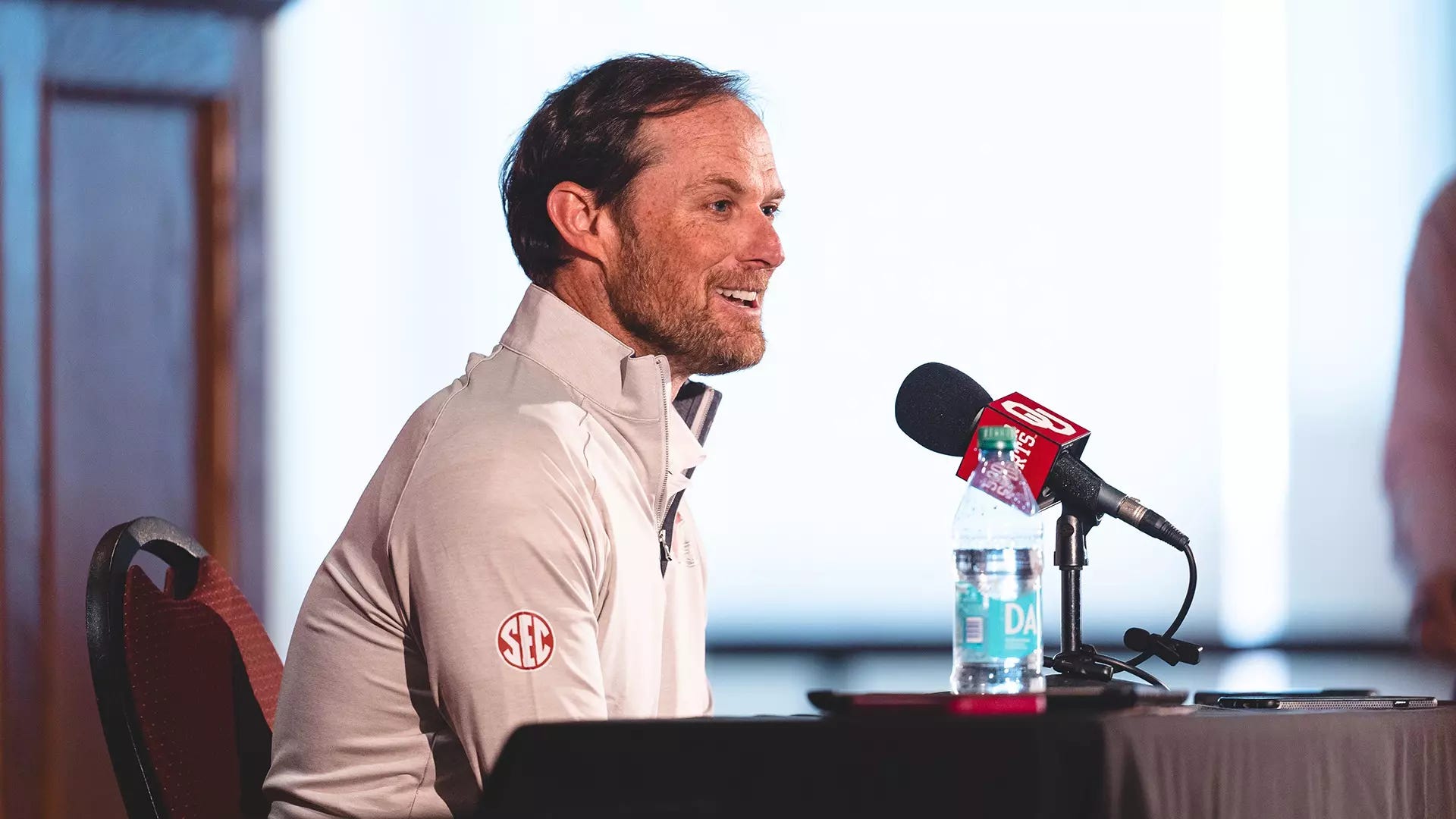
Fish around and you’ll find links to press conferences from both head coach Brent Venables and Sooner football general manager Jim Nagy.
Plenty on them later.
If you’d like a just a quick summary of Sooner signing day, here’s that, too.
Oklahoma signed 24 high school prospects on Wednesday, the first day of the three-day early signing period, matching its commitment list entering the day, which is no small thing.
The class includes five Texans, five Floridians, three Californians, two Arizonans, two Hoosiers and, regrettably, only one Oklahoman, Xavier Okwufulueze from Class 2A Rejoice Christian in Owasso.
The Sooners also picked up one prospect each from Alabama, Arkansas, Delaware, Kansas, Colorado and Missouri.
You may not have noticed, but Venables was sure to point that means 10 of the 24 came from in-state or bordering states, so, kind of, sort of, OU still beats the bushes of its region.
The recruiting rankings, of course, are out, too.
While Venables and Nagy sounded as though they couldn’t have been more pleased, contending the secret sauce to be the relationships already formed and the character of the prospects signed, the class is not so highly ranked.
ESPN claims it the No. 16 haul in the nation, 247Sports also has it 16th and Rivals has it 17th.
Or, another way to look at it, ESPN has it eighth among SEC programs, as does 247Sports and Rivals has it 10th.
It’s worth pointing out rankings don’t matter until said prospects get on the field; not to mention, huge discrepancies in exist within the rankings.
Texas, for instance, is No. 2 by ESPN, yet eighth and 10th by 247Sports and Rivals. North Carolina is 12th by ESPN, but 17th and 18th by 247Sports and Rivals.
From the if-you-can-believe-it file, Southern Cal’s a unanimous No. 1.
So there’s your quick wrap, though that’s not what this column’s about.
It’s about how the sausage gets made, because for the first time in decades, it’s being made differently.
Going first on Wednesday, Venables didn’t speak much about the process, only that he’s loving the collaboration and cooperation with Nagy’s player personnel staff.
“It’s the new college model and our vision is to be best in class,” Venables said, “class” being a synonym for “process.”
“In order to do that, you’ve got to work together … So, there’s a relational piece, there’s a trust piece, there’s a roll-up-your-sleeves-and-get-to-work piece. But the best part of all of it is just doing it together and it’s been fantastic.”
Sounds good.
After Venables came Nagy, who, with a very fresh voice, spilled the beans.
It’s a fresh voice because he doesn’t work for Venables, exactly, but alongside him. So the head coach isn’t in his ear about what to say and what not to say.
If Nagy was guarded, which is possible, he was still less guarded than any football coach I’ve encountered at any level.
Like, when had we ever heard this before, arriving in Nagy’s opening statement, as he thanked everybody?
“The MVPs of the last 48 hours, Grayson Fuller, with our legal counsel, getting all these contracts prepared, and Danielle Cowal, from compliance, have done unbelievable [jobs],” he said. “I don’t think they slept last night.”
Legal counsel? Contracts?
Interesting.
That was just an aside.
Then came the real stuff.
Recruiting has always been on the coaches. Not just the road work to see and meet, to walk into living rooms and sell a vision, but player evaluation, too, identifying prospects, going through hours and hours of what they call “film” but is actually video, eliminating prospects, creating target lists.
Well, that’s no longer on the coaches.
Nagy explained.
“It will start at the lower levels of the scouting staff, everyone’s got states and regions and then we crosscheck by position,” he said. “So, rather than just a coach or two having their eyeballs on a player, we have seven or eight grades on a particular player.
“So then it will get to [assistant general managers] Luke [Dawson] and Taylor [Redd] and myself and coach [Venables] and the position coaches, and if we don’t see eye to eye …
“We call them discrepancy meetings, and we’ll watch the player and if we still can’t get on the same page, then we move on. There’s a million high school players out there and if we don’t see eye to eye, we’ll move on and find a new guy.”
It’s a revolution is what it is.
Practically, it gives the coaches significantly more time to spend on their team or perhaps head home a little earlier.
“The selling, recruiting on the official visits, that time has been bought back from the coaches,” Nagy said. “So they’re not sitting at their desk watching a couple hours of high school tape every day. That [time’s spent] more into development.”
It’s sort of the way the presidency and the justice department used to work.
They’re on the same team, belong to the same branch, but used to work independently until collaboration in the interests of both became required.
It’s, as Venables said, the “college model,” where, at least for now, the head coach, making the big money, holds more sway in the program. And still one wonders if that might someday flip to the GM being prime mover, as general manager Sam Presti is to Oklahoma City Thunder coach Mark Daigneault.
Wherever it eventually goes, it’s already a whole new ballgame.
Putting together the class, the coaches began way out ahead of Nagy’s department, which began coming online last March.
Perhaps less discrepancy meetings will be required in the future, but don’t count on it.
“If a coach gets a call from a coaching friend that [says], ‘Hey, you’ve got to come and check out my guy,’ and it’s not someone that has been passed along from the scouting staff, like, of course, [the coach] comes to us, like, “Hey, my coaching buddy gave me this name, will you guys watch him?’” Nagy said. “I’m not saying it won’t ever happen where coaches bring us players [in the future]. It will probably happen a lot.”
Such instances will have to be navigated, Nagy’s staff, not the coach who got the call, doing the evaluating.
It must have helped that Nagy and company entered the process humbly.
“Every conversation when we brought our guys aboard was like, ‘Guys, put your head down and go to work … we have to earn their respect … this coaching staff, this is new to them,’” Nagy said. “‘This is foreign to them, it’s never been done, so we need to come in and earn their respect.’
“So that’s what we’ve done.”
The class is the class.
We’ll see how it works out, if it works out.
But the process?
Welcome to the new frontier.
Just maybe, the Sooners are ahead of the game.