

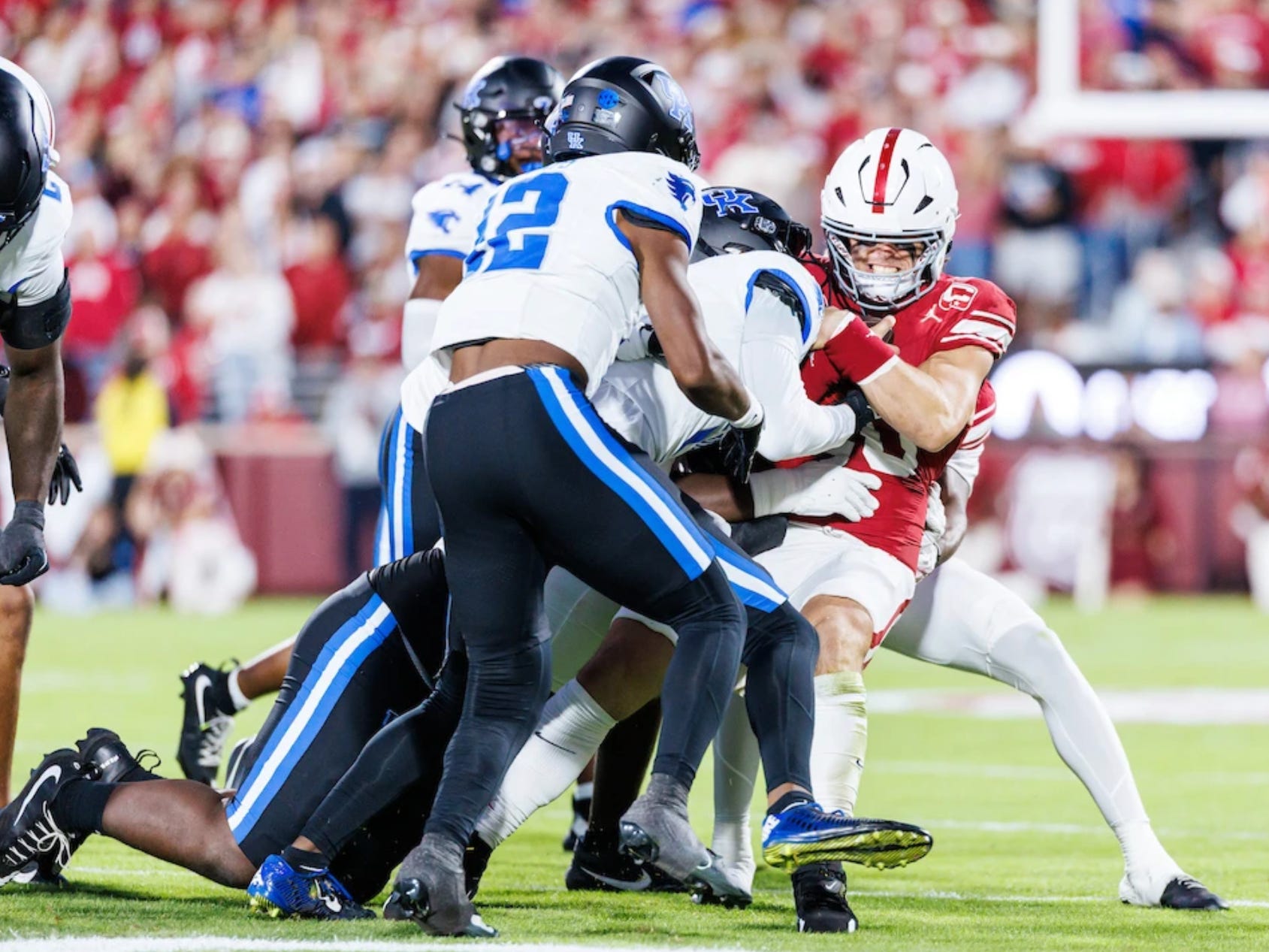
At the half, coming off the field, his team up three points and headed to the locker room, an SEC Network reporter caught up to Brent Venables.
Among other things, the Sooner head coach said, it’s going to be a fourth-quarter game.
But why?
Oklahoma would go on to lose 21-13 but it was 10-7 Sooners at the time, their having gone on first-half drives of 49, 47 and 90 yards.
The first became a 44-yard Tate Sandell field goal. The second would have been a touchdown had holder Jacob Ulrich only been able to hit a wide open Rocky Beers, yet for no good reason beyond the excitement of pulling off a trick play jump-threw right to Kentucky’s Jordan Castell instead. The third accounted for seven points, a 20-yard toss from John Mateer to Beers.
OU led 10-7, it should have been 17-7 and the Wildcats had accounted for only 52 yards, three first downs and no points since their game-opening drive concluded.
So why did OU’s head coach think, sure, it’s going to be a fourth-quarter game?
Does he want every game to be a fourth-quarter game?
Can he not envision ever winning by two, three or four touchdowns?
The game over, meeting the media, Venables offered more.
“We had plenty of opportunity there late into the third quarter to knock them out,” he said. “We just weren’t able to get it done.”
Except that’s wildly inaccurate, because at no point was OU in position to make it more than a two-score game with less than a quarter to play.
Do they now allow happy-hour 14-point touchdowns if scored in the third quarter on your home field between 9 and 10 p.m.?
Or are defensive-minded head coaches, who can’t make themselves care about offense anywhere near the level they care about defense, simply prone to believing nine- or 13-point third-quarter leads to be insurmountable, because they can’t imagine an offense, any offense, including their own, capable of putting real points on the board?
Venables spoke more.
“I do think having the right perspective is important, to see where we did make some improvement,” he said. “We had three drives in the first half that were well over 10 plays.”
Yeah, the Sooners did, accounting for the yardages and results mentioned.
But only OU’s offense could put together a drive lasting so long that so rarely fails to net seven points and frequently yields none. Only OU could rack up 346 yards of total offense, 116 more than its opponent, and turn it into so little.
Of course, to this team, led by this head coach, it’s almost expected. Because to him, that’s what college football’s about.
It’s not one bit about what OU football used to be, populated by terrific offensive lines, running backs, receivers and quarterbacks capable of scoring 40, 50 and 60 points.
Because once the Sooner offense was all about racking up those numbers, yet this one can’t net 20; not against Michigan, New Mexico, Georgia, Texas and not against Kentucky.
“I have a great appreciation for the fight,” Venables said, speaking of his offensive line. “Thought we threw from, for the most part, good clean pockets. We did have some success running the ball at times. I thought they did some really good things.”
He doesn’t do it often, only sometimes, referring to his offense, or units of his offense, as “they” and not “we.” Still, we’re waiting for the first time he mistakes his defense for “they.”
The game was about a lot of other things, too.
The “knockout” never came because, facing first-and-10 at the Kentucky 38, Mateer’s right arm was clipped from behind by Wildcat Mi’Quise Humphrey-Grace, sending the ball high into the air and short of any intended Sooner receiver, leaving Ty Bryant to pick it off and bring it back 43 yards to the OU 44.
Who knew how fragile the Sooners remained following their Cotton Bowl miracle, but here it came.
Kentucky needed seven plays to reach the end zone, quarterback Kenny Minchey finding Willie Rodriguez from 22 yards, putting the Wildcats on top 14-13.
Next, OU went three and out, Mateer getting sacked twice.
Kentucky then drove it 48 yards to the Sooner 5, before Wildcat head coach Will Stein horrendously went for it on fourth-and-goal only for Minchey to be sacked, meaning all the Sooners needed was to set Sandell up from 60 yards or less to win the game.
On three incompletions, OU went three and out again.
Still, the Sooners got the ball back with 2:43 remaining, setting up at their own 4, and showing no urgency at all, reached their own 32 with 1:25 remaining, calling time out to stop the clock.
On the next snap, Mateer threw well behind Manny Choice, Castell nabbed his second pick and brought it back 41 yards to paydirt.
The Sooners died after Mateer’s first pick. The second made it official.
The game finished as though he’d never thrown for 229 yards through three quarters, completing 19 of 29 attempts.
It finished as though the Sooner offense had been utterly inept the whole way, only able to rack up a TD and two field goals.
It finished as though it was just more of the same, just like it had been against the Lobos, Wolverines, Bulldogs and Longhorns.
But it wasn’t.
The Sooner offense played better than it had against anybody, save UTEP.
It did everything but score the points.
Maybe if it had a coach who valued offense it would be different.
Too bad, as we’ve come to know, it will take north of $50 million to find out.
This is Sooner football.
The first interception was the result of Mateer doing what he often does, waiting too long to let the ball go. The other one was just a brain fart at the worst possible moment. And Kentucky never looked worried, despite their offensive problems.